

Looking for a Shorter Overview?
AI Summary
Key Moments
Common failure patterns at the Louvre
Weak or reused passwords, legacy neglected systems, and ignored security warnings led to vulnerabilities.Broader implications of weak credentials
Recent large-scale credential leaks and attacks on infrastructure show the pervasive risk.Reasons weak passwords persist
Busy users, unsupported apps, shared accounts, and shadow IT contribute to poor password practices.Uniqkey solutions
Strong unique passwords, effortless MFA, visibility, control, and SSO complement to close security gaps.The Louvre used “Louvre” as a password. Funny? Sure. Frightening? Absolutely.
When one of the world’s most famous museums has a video security server protected by the password “Louvre”, it is tempting to laugh. Then you remember the October jewel heist, and the laughter stops. Multiple reports now indicate the museum’s surveillance systems ran with trivial credentials for years, alongside ageing infrastructure, with auditors warning as far back as 2014. The current investigations will take time to conclude, yet the lesson for any European organisation is immediate. Weak passwords still open doors. A lot of them.
What actually went wrong at the Louvre
Audits and press reports point to three failure patterns we see every week in European businesses:
- Passwords that are guessable or reused. “Louvre” guarded a core system that should have been protected by unique credentials and multi-factor authentication.
- Legacy systems left untouched. Outdated servers and delayed upgrades make it very hard to enforce modern authentication.
- Security warnings ignored. Findings from earlier audits were not translated into controls and ongoing oversight.
This combination is exactly what attackers hope to find. It is also precisely what European regulations such as NIS2 are pushing organisations to fix through stronger access control and encryption, timely incident reporting and management accountability.


This is not a one-off. 2025 has been a wake-up call
If you think “no one else would ever do that”, consider a few recent cases that underline the same theme.
- A compilation leak exposed an estimated sixteen billion credentials this summer. Even if only a fraction of them work, password reuse turns one compromise into many.
- Analysts continue to find that stolen or weak credentials are a top driver in breaches. The latest DBIR material again highlights credential misuse as a leading pattern.
- Industrial systems are not immune. A 2025 case study on a Norwegian dam describes a web HMI left online behind a weak password, allowing remote manipulation until operators intervened. Critical infrastructure plus easy credentials is a terrible mix.
- In late October, a separate trove of 183 million email and password pairs surfaced, much of it harvested by infostealer malware. Again, reuse turns a credential dump into a real business risk.
Why weak passwords still dominate risk
Because people are busy. Because many apps do not support SSO. Because shared accounts still exist. Because shadow IT is real and sprawling. That is why independent sources and our own material continue to show that password practices sit at the heart of most breaches.
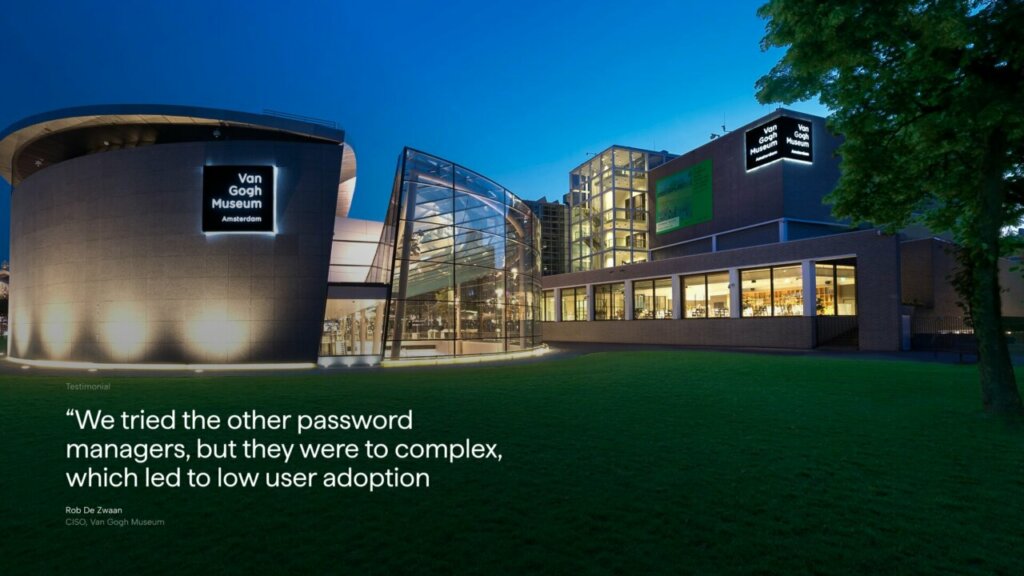
To borrow one of our favourite customer quotes, simple wins adoption. That matters for security:
How Uniqkey closes the gaps the Louvre story exposes
Protect every login with strong, unique credentials
Generate and auto-fill long, unique passwords for every service, including those outside SSO coverage. Enforce policies without relying on end users’ heroics.
Make multi-factor effortless
Built-in TOTP means employees do not juggle extra apps. Automatic code entry removes friction while raising the bar for attackers.
Gain complete visibility and control
See who has access to what. Spot weak and reused passwords. Get alerts when a company’s accounts are breached. Audit sharing. Streamline onboarding and offboarding. Produce the evidence your compliance team needs in minutes.
Work with SSO, not against it
We complement SSO to cover everything SSO does not, so there is no blind spot across cloud and desktop services.
The simple test every organisation should run this week
- Pick 5 business systems that are not behind SSO.
- Check whether passwords are reused, unique and rotated.
- Check if any of the services have been breached.
- Turn on MFA for each of the services which are missing
- Review complete access lists and kill unused accounts.
If any of those steps feel hard, you have the very gaps the Louvre story highlights.