
Looking for a Shorter Overview?
AI Summary
Key Moments
Compliance blind spots due to unmanaged SaaS and AI
Untracked cloud services and AI usage lead to unknown risks, unprotected accounts, and regulatory gaps.Regulatory frameworks require complete, accurate asset inventories
NIS2, DORA, GDPR and the EU AI Act all mandate up-to-date inventories with access controls and supplier oversight.Uniqkey Discovery enables continuous SaaS and AI visibility
It automatically maps services from real sign-ins, showing login methods and MFA adoption without complex rollouts.Continuous discovery improves incident response and audit readiness
Up-to-date data shortens breach impact analysis and provides evidence for audits, reducing manual work and guesswork.Ask a compliance officer which suppliers process company data, and you will get a list. Ask how the list was built, and the answer is usually procurement records, a spreadsheet and a yearly round of emails to department heads.
That list describes what the organisation bought. It does not describe what people use.
A finance colleague signs up for a forecasting tool with a work email. A project team adopts a customer’s collaboration platform. Someone pastes a contract into an AI assistant on a private account. None of it passes procurement, so none of it reaches the register, the risk assessment or the auditor.

You can’t protect what you can’t see. You can’t document it either.
The gap is widening. In 2025, 52.7% of EU enterprises paid for cloud services, up from 17.8% in 2014, according to Eurostat. AI is moving faster still: Eurostat reports that 20% of EU enterprises with 10 or more employees used AI in 2025, up from 13.5% a year earlier. The Nordics lead, with Denmark at 42%, Finland at 37.8% and Sweden at 35%.
Read also: Shadow IT Explained: In-Depth Guide (with Examples)
For compliance teams, this comes down to two questions: Which services do our people actually use? And can we prove how access to them is protected?
Uniqkey Discovery answers both, continuously, from real sign-in activity.
It is not an audit tool. It is built for IT and security teams who want to work from real-time data, so risk assessments, priorities and strategy rest on what is actually happening rather than on estimates. Compliance benefits because the same data doubles as evidence.
This article covers what is at stake, what European regulation expects, and where Discovery fits, including the uses that have nothing to do with an audit.
Why compliance teams are working blind
A supplier register is only as good as its inputs. Most are assembled from sources that each miss part of the picture.
| Source | What it misses |
| Procurement and finance records | Free plans, trials and tools paid on a personal or team card |
| Identity provider reports | Every service that was never connected to SSO |
| Department surveys | Tools people forgot, and everything adopted after the survey closed |
| Last year’s spreadsheet | A full year of new sign-ups |
AI makes the gap harder to ignore. In a Bitkom survey of 604 German companies with 20 or more employees, 8% reported widespread use of private AI tools at work and 17% reported individual cases. A further 17% suspected it without being able to confirm. Only 23% had rules for generative AI in place.
Read that third figure again. Roughly one company in six believes shadow AI is happening and cannot say where.
The pattern holds beyond AI. ENISA’s NIS Investments 2025 study of 1,080 organisations across the EU found that almost one in three had not carried out a cybersecurity assessment in the past 12 months. Supply-chain risk management ranked among the hardest parts of NIS2 to implement, named by 37%.
A register updated once a year is wrong for most of that year. Auditors know it, and so do attackers.

The cost of working blind
An incomplete register is easy to treat as a paperwork problem. In practice it carries four separate costs.
An unknown service is an unprotected login
A service nobody knows about has no MFA policy, no owner and no place in the offboarding checklist. It still holds company data behind a password.
That is exactly where attackers start. ENISA’s Threat Landscape 2025 analysed 4,875 incidents and found phishing was the leading way in, at about 60% of observed cases. The 2026 edition adds that attackers keep targeting cyber dependencies through supply-chain and third-party attacks, which tend to produce the largest incidents. It also found that 73% of targeted organisations were essential or important entities under NIS2.
Every unmanaged SaaS account is a third-party dependency you have not assessed.
The bill keeps growing
Bitkom’s Wirtschaftsschutz 2026 study of 1,003 German companies puts annual damage from data theft, espionage and sabotage at between €211 billion and €270.8 billion. Cyberattacks account for 76% of it.
Those are German figures, from Europe’s largest economy. No comparable EU-wide loss estimate exists, but the direction is the same everywhere ENISA looks.
Fines, and personal accountability
Under NIS2, essential entities face fines of up to €10 million or 2% of global annual turnover. Important entities face up to €7 million or 1.4%.
The bigger change is who answers for it. Article 20 requires management bodies to approve cybersecurity risk measures, oversee them, and be held liable for infringements. For essential entities, authorities can temporarily ban a responsible executive from managerial functions.
In Denmark, the NIS2 Act has applied since 1 July 2025, and security must now be anchored in top management, which has to document its efforts. “We did not know the service existed” is not documentation.
Shadow AI moves data you are responsible for
When an employee pastes customer data into an unapproved AI tool, the organisation has gained a data processor. There is no data processing agreement, no entry in the record of processing activities, and possibly a transfer outside the EU.
GDPR does not distinguish between processors you chose and processors you failed to notice. Infringements of the controller and processor obligations carry fines of up to €10 million or 2% of global turnover.
The hours nobody budgets for
Then there is the quiet cost. Before every audit, certification, customer questionnaire or insurance renewal, someone rebuilds the list by hand. They compare procurement exports, chase department heads and reconcile identity provider reports.
The result is out of date the week it is finished. The same work starts again next quarter.
What European regulation actually asks for
The frameworks differ in scope and language. On SaaS and AI use, they ask for remarkably similar things.
| Framework | What it expects | The question you will be asked |
| NIS2, Article 21 | Asset management, access control policies, MFA where appropriate, and supply-chain security covering direct suppliers and service providers | Which services do you rely on, and how is access to them protected? |
| NIS2 Implementing Regulation 2024/2690 | A complete, accurate and up-to-date asset inventory, and MFA matched to the classification of the asset | Show us the inventory. When was it last updated? |
| DORA, Articles 8 and 28 | Identify and document all ICT assets, keep a register of every ICT third-party arrangement, and hold exit strategies for critical services | Is every ICT provider in your register of information? |
| GDPR, Articles 28, 30 and 32 | A contract with every processor, a record of processing activities, and security appropriate to the risk | Which tools process personal data, and under which agreement? |
| EU AI Act, Article 4 | Measures to build AI literacy among staff who use AI systems, in force since February 2025 | Which AI tools are your people using, and what guidance have they had? |
| ISO/IEC 27001:2022, Annex A | An inventory of information assets, secure authentication, and security for cloud services and suppliers | Where is the evidence that this control operates? |
Two details deserve attention.
First, the Implementing Regulation is directly binding only for digital providers such as cloud, data centre and managed service providers. National authorities and auditors nonetheless use it as the reference for what a good inventory looks like.
Second, the AI Act’s literacy duty applies to ordinary business use. The European Commission confirms that a company whose employees use ChatGPT to write or translate text falls under Article 4. National authorities have supervised the rule since August 2026. The Digital Omnibus softened the wording in July 2026, but the obligation remains.
Strip away the article numbers and four expectations remain: know your services, control access to them, know your suppliers, and prove all three on an ongoing basis.
That last part is the hard one. ENISA found that 70% of organisations name regulatory compliance as the main driver of their cybersecurity investment. The pressure is real. The evidence is what is missing.
What is Uniqkey Discovery?
Uniqkey Discovery is a standalone SaaS and AI visibility product. It maps every service employees sign in to and shows how each login is protected: SSO, MFA, passkey or a standalone password.
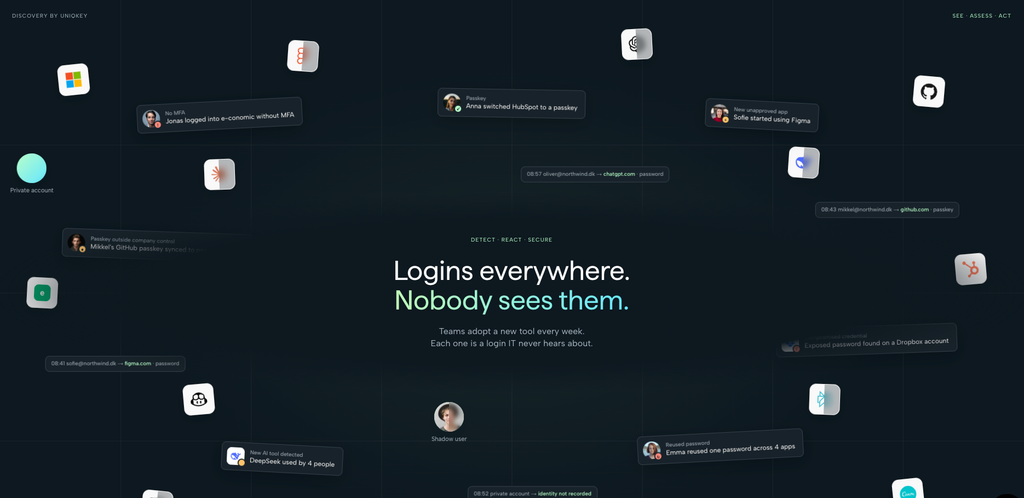
It is rolled out once to company browsers through existing device management. Employees install nothing and change nothing. The inventory builds itself from daily sign-ins, so the evidence starts arriving with the first logins.
| Area | What it gives compliance |
| SaaS and AI inventory | A living register of the services actually in use, including the ones nobody approved |
| MFA adoption | Proof of MFA per service and per user, including finance systems and portals outside Microsoft and Google |
| Passkey adoption | Where passkeys are used, and which ones sit in personal Apple or Google accounts outside company control |
| SSO coverage | How much real login activity runs through the identity provider, and what sits outside it |
| Security overview | An organisation security score, password-strength signals and the gaps to close first |
| Evidence exports | Documentation for auditors, customers, insurers and the board, drawn from observed activity |
Discovery works on its own. There is no password manager to roll out, no employee onboarding, and no need to replace your identity provider or migrate a single application.
It rests on three pillars:
- SaaS governance: know every service in use, who uses it and who owns it.
- AI governance: see which AI tools are in use, by how many people, and whether they are approved.
- MFA and passkey adoption: measure how people actually sign in, and whether it improves.
Uniqkey is a cyber security company focused on password and access management. Discovery came out of a simple question customers kept asking: are our security policies and initiatives actually working? Discovery shows the answer in data. For organisations under NIS2, that delivers much of the overview and monitoring Uniqkey’s password and access manager provides, without the rollout.
From obligation to evidence
Discovery turns each of those audit questions into something you can show, not something you have to assert.
| Compliance question | Evidence Discovery supplies |
| Which cloud services do we use? | An inventory built from real sign-ins, updated as new services appear |
| Can we prove MFA on critical services? | MFA use per service and per user, exportable, including services outside Microsoft and Google |
| Which AI tools are in use? | Every AI service employees sign in to, flagged when it appears, with the number of people using it |
| Which suppliers are missing from our register? | Services in daily use that never passed procurement or a security review |
| How much does SSO really cover? | The share of login activity through the identity provider, and the long tail outside it |
| What happens when someone leaves? | Services and passkeys tied to individuals, visible before the departure |
| Are we improving? | Trends in MFA, passkey and SSO adoption, month after month |
The working rhythm is simple.
- Discover. See every service and how each login is protected.
- Prioritise. Start with business-critical services and the riskiest habits.
- Close. Enforce MFA, assign owners, move services behind SSO.
- Measure. See whether your policies and initiatives actually change how people sign in, and export that progress when someone asks for it.
One point of honesty belongs here. Discovery supplies visibility and evidence. It does not make an organisation compliant on its own. Compliance still depends on policies, governance, people and the controls themselves. What Discovery removes is the guesswork underneath them.
Control by control: where Discovery fits
The tables below map Discovery to the specific articles and control points compliance teams work with. Use them to find your framework, see which requirement is in play, and what Discovery contributes to it.
In every case Discovery supplies evidence or input for the control. The control itself, and the decision on whether it is met, stays with you and your auditor.
NIS2 Directive (EU) 2022/2555
| Reference | What it requires | How Discovery helps |
| Art. 20 | Management approves and oversees cybersecurity risk measures | A security score and trend reporting built on observed logins, ready for the board |
| Art. 21(2)(a) | Risk analysis and information system security policies | A factual list of services and login weaknesses to feed the risk assessment |
| Art. 21(2)(d) | Supply-chain security, including direct suppliers and service providers | Surfaces SaaS and AI providers in daily use that are missing from the supplier list |
| Art. 21(2)(f) | Policies to assess whether security measures are effective | Measures whether MFA, passkeys and SSO are actually adopted, over time |
| Art. 21(2)(g) | Basic cyber hygiene practices and training | Shows weak and reused passwords and password-only logins, so training targets real habits |
| Art. 21(2)(i) | Access control policies and asset management | A live inventory of services, with who signs in and how |
| Art. 21(2)(j) | Multi-factor authentication where appropriate | MFA use per service and per user, exportable as evidence |
| Art. 23 | Early warning within 24 hours of a significant incident | Shows the same day who uses an affected service and how their accounts were protected |
The Implementing Regulation (EU) 2024/2690 spells these out further. Its Annex is binding for digital providers and widely used as a benchmark by others.
| Annex point | What it requires | How Discovery helps |
| 5.2 Directory of suppliers and service providers | An up-to-date registry of direct suppliers and service providers | Finds the service providers the registry is missing |
| 11.6 Authentication | Secure authentication procedures, with strength matched to the asset | Shows the login method used on each service |
| 11.7 Multi-factor authentication | MFA or continuous authentication, matched to asset classification | Per-service MFA evidence, with critical services flagged |
| 12.4 Asset inventory | A complete, accurate, up-to-date and consistent inventory | The SaaS and AI part of the inventory, maintained from daily sign-ins |
| 12.5 Return or deletion of assets on termination | Assets and access handled when employment ends | Services and personal passkeys tied to a leaver, visible in advance |
ISO/IEC 27001:2022, Annex A
| Control | What it requires | How Discovery helps |
| A.5.9 Inventory of information and other associated assets | An inventory of assets with owners, kept current | Discovers cloud services and helps assign an owner to each |
| A.5.15 Access control and A.5.18 Access rights | Rules for access, and regular review of access rights | Shows who actually signs in to which service, as input to access reviews |
| A.5.16 Identity management and A.5.17 Authentication information | Managed identities and protected credentials | Flags company services used outside SSO and password-strength weaknesses |
| A.5.19 and A.5.22 Supplier relationships and monitoring | Managing supplier risk and reviewing supplier services | Reveals unassessed suppliers and shows which ones are really in use |
| A.5.23 Information security for use of cloud services | Processes for acquiring, using, managing and exiting cloud services | A view of cloud services in use, including those acquired outside the process |
| A.6.5 Responsibilities after termination | Access and duties handled when people leave or change role | Lists the services a leaver signs in to, beyond what the identity provider knows |
| A.8.5 Secure authentication | Authentication technology matched to access restrictions | Evidence of MFA, passkey and SSO use across services |
| Clause 9.1 Monitoring and measurement | Evaluating whether the ISMS performs | Adoption metrics for MFA, passkeys and SSO as ready-made security indicators |
SOC 2 (AICPA Trust Services Criteria)
| Criterion | What it requires | How Discovery helps |
| CC3.2 Risk identification | Identifying risks across the entity, including from vendors | Surfaces unknown services and unprotected logins as identified risks |
| CC4.1 Monitoring activities | Ongoing evaluation that controls are present and functioning | Continuous measurement instead of point-in-time sampling |
| CC6.1 Logical access security | Inventory of information assets and protected access, including authentication | Service inventory plus login method per service |
| CC6.2 and CC6.3 User access provisioning and removal | Access granted, changed and removed in line with roles | Finds accounts created outside provisioning that offboarding would miss |
| CC9.2 Vendor and business partner risk | Assessing and managing vendor risk | A list of vendors in actual use to run through vendor assessment |
A SOC 2 Type II report covers a period, typically six to twelve months. Evidence that is collected continuously fits that model far better than a screenshot taken the week before fieldwork.
ISAE 3402 and SOC 1
ISAE 3402 and SOC 1 have no fixed control catalogue. The service organisation defines its own control objectives, and the auditor tests them. Discovery helps with the IT general controls that almost every such report contains.
| Area in the report | What the auditor tests | How Discovery helps |
| Logical access controls | That access to relevant systems is restricted and authenticated | Evidence of MFA and login method on systems in scope, across the period |
| User administration | That access is granted on approval and removed on departure | Shows accounts on services outside the central identity platform |
| Subservice organisations | That third parties relevant to the service are identified and described | Helps confirm no relevant SaaS provider is missing from the system description |
| Type 2 operating effectiveness | That controls worked throughout the period, not only at one date | Month-by-month data instead of a single snapshot |
If you receive ISAE 3402 reports from your own suppliers, the same inventory tells you which suppliers you should be requesting them from.
DORA, Regulation (EU) 2022/2554
| Reference | What it requires | How Discovery helps |
| Art. 5(2) | The management body bears ultimate responsibility for ICT risk | Fact-based reporting on the SaaS estate and access security |
| Art. 8(1) and 8(4) | Identify, classify and document ICT assets and their dependencies | Discovers ICT services in use that the asset register does not list |
| Art. 8(6) | Keep inventories updated, including after major changes | An inventory that updates itself as new services appear |
| Art. 9(4)(c) and (d) | Limit access to what is needed, with strong authentication mechanisms | Shows where strong authentication is and is not used |
| Art. 28(3) | A register of information on all ICT third-party arrangements | Identifies ICT providers in use that never entered the register |
| Art. 28(8) | Exit strategies for ICT services supporting critical functions | Shows who depends on a service, as input to exit planning |
The supporting technical standard, Delegated Regulation (EU) 2024/1774, adds detail in Articles 4 and 5 on ICT asset management, Article 20 on identity management and Article 21 on access control. Discovery’s inventory and authentication evidence support all four.
GDPR and the EU AI Act
| Reference | What it requires | How Discovery helps |
| GDPR Art. 5(2) and 24 | Accountability: being able to demonstrate compliance | Documented, dated evidence of services and access protection |
| GDPR Art. 28 | A contract with every processor | Finds tools that may be processing personal data without an agreement |
| GDPR Art. 30 | A record of processing activities | Flags services to check against the record |
| GDPR Art. 32 | Security appropriate to the risk | Shows where access to personal data rests on a password alone |
| GDPR Art. 33 | Breach notification within 72 hours | Quick scoping of who used a breached service |
| AI Act Art. 4 | Measures to build AI literacy among staff using AI | Shows which AI tools are in use and by how many, so training is targeted |
| AI Act Art. 26 | Deployer duties for high-risk AI systems | Helps establish which AI systems the organisation is deploying in the first place |
Discovery sees that a service is used. It does not see what data goes into it. Whether a tool processes personal data is an assessment your DPO makes, starting from a complete list.
Cyber Resilience Act, Regulation (EU) 2024/2847
The CRA is a product regulation. It governs manufacturers of products with digital elements, and Discovery does not assess product conformity. Its contribution is narrower and concerns the manufacturer’s own environment.
| Reference | What it requires | How Discovery helps |
| Art. 13 and Annex I, Part I | Products designed and developed securely, protected against unauthorised access | Shows how logins to code repositories, build pipelines and AI coding tools are protected |
| Art. 13(5) | Due diligence on third-party components | Reveals unapproved development and AI services engineers sign in to |
| Art. 14 | Reporting of exploited vulnerabilities and severe incidents, in force since 11 September 2026 | Helps scope quickly whether a compromised developer service is in use |
The main CRA obligations apply from 11 December 2027. Manufacturers preparing now will find that the security of the development environment starts with knowing which tools the engineers actually use.
Beyond the audit: where the same map pays off
An accurate picture of your SaaS estate is useful long before an auditor asks for it. These are the situations where organisations feel its absence most.
| Situation | Without a live map | With Discovery |
| Replacing a vendor | Nobody knows who uses the tool or what depends on it | Users, teams and login methods are known before the project starts |
| A service shuts down or is breached | Days spent finding out who is affected | Affected users identified the same day |
| Mapping the estate | Weeks of spreadsheets, repeated before every review | The map maintains itself from daily sign-ins |
| Offboarding | Orphaned accounts surface months later | Services and personal passkeys visible before the last day |
| Customer and insurer questionnaires | Answers based on policy and estimates | Answers based on exported evidence |
| Sovereignty review | No list of what to assess | A full list of services to check for hosting and jurisdiction |
Replacing a vendor
Vendor replacement fails in the planning stage more often than in the migration. The contract names 50 licences, but nobody can say which teams actually sign in, which use a shared account, or which other tools were adopted to work around it.
Discovery shows who uses a service, how often it appears in daily work, and how people authenticate. That gives the project a real scope, and it gives procurement a real number to negotiate with.
The timing matters. The EU Data Act has applied since September 2025 and gives customers of cloud services the right to switch providers. From 12 January 2027, providers may no longer charge switching fees at all. Switching is becoming cheaper by law. Knowing what you would be switching is still up to you.
When a service shuts down or is breached
SaaS vendors get acquired, discontinue products and suffer breaches. When the notice arrives, the first question is always the same: are we affected, and who?
With a sign-in-based inventory, the answer takes minutes. You can see whether the service is in use, by whom, and whether those accounts were protected by MFA or only a password. That matters when NIS2 gives you 24 hours for an early warning and GDPR gives you 72 hours to notify a breach.
For financial entities, DORA goes further and requires documented exit strategies for ICT services that support critical functions. An exit strategy for a service you did not know you depended on does not exist.
Hours saved mapping your infrastructure
Manual SaaS mapping is slow because the information lives in five places and belongs to nobody. Discovery replaces the exercise with a view that is already current.
The time saved is not only IT’s. Compliance stops chasing department heads. Department heads stop filling in surveys. The annual scramble before an ISO 27001 surveillance audit becomes an export.
Offboarding, mergers and reorganisations
When someone leaves, the accounts IT knows about get closed. The ones created with a work email and a personal password do not.
Discovery shows services tied to an individual before the departure, including passkeys synced to a personal Apple or Google account. The same applies at scale during a merger, when two unknown estates have to become one known estate.
Customer questionnaires, cyber insurance and board reporting
Security questionnaires from customers ask the same things auditors do: is MFA enforced, do you maintain an asset inventory, how do you govern AI? So do cyber-insurance applications.
Answering from evidence is faster and safer than answering from policy. It also gives management what NIS2 expects it to have: reporting built on facts, with a trend line.
Digital sovereignty reviews
European organisations are looking harder at where their software comes from. Denmark’s Ministry of Digitalisation and the German state of Schleswig-Holstein have both begun moving away from Microsoft Office to reduce dependence on a small number of foreign suppliers.
Most organisations will not go that far. Many will still be asked by their board which services sit outside European jurisdiction. That question starts with a complete list, which Discovery provides. From there, our European Alternatives directory can help with the next step.
Practical examples
These examples are illustrative. They are not claims about specific Uniqkey customers.
Example: the auditor asks for proof of MFA
A 250-person logistics company falls under NIS2 as an important entity. Its auditor asks how the company knows MFA is used on business-critical services.
The IT manager can show the conditional access policy in Microsoft Entra ID. That covers the connected applications. It does not cover the accounting platform, the carrier portal or the HR system, which all sit outside SSO.
With Discovery, the company exports MFA use per service and per user. It shows the gaps, the owner assigned to each, and coverage rising over three months. The auditor sees a control that operates, not a policy that exists.
Example: a supplier announces end of service
A file-sharing tool announces it will shut down in 90 days. Procurement has no contract on record, so the notice is nearly ignored.
Discovery shows 34 employees across three departments signing in every week, most with a password only. The compliance team learns in an afternoon what would otherwise have surfaced on shutdown day. Data is moved, a replacement is chosen, and the processor record is corrected.
Example: the AI policy meets reality
A professional services firm publishes an AI policy naming one approved assistant. Six months later, management wants to know whether it worked.
A survey would report what people remember and are willing to admit. Discovery shows four AI services in use, one of them on private accounts. The firm now knows where to focus its AI literacy training, which tool to evaluate for approval, and which to block.
Example: the board asks about sovereignty
A municipality’s board asks which systems depend on providers outside the EU. The IT department can list the large platforms from memory.
Discovery adds the 80 smaller services nobody listed. The team classifies them by hosting location and criticality, and brings the board a prioritised plan in place of an estimate.
Privacy and employee questions
A compliance tool that creates a privacy problem solves nothing. Discovery is built to give visibility without surveillance, and these are the questions DPOs and works councils ask first.
Is Discovery employee monitoring?
No. Discovery records sign-in events and nothing else: the service, the login method, whether MFA or a passkey was used, a password-strength score, whether the sign-in succeeded, and when.
It never collects passwords, page content, emails, messages, documents, keystrokes, screenshots or general browsing history.
What happens with private accounts?
Discovery separates verified company domains from everything else. On a private domain, no username or email is collected. Administrators never see who signed in or how. Those sign-ins appear only as an anonymous, organisation-wide count.
Does Discovery see passwords?
Never, in any form. Password strength is scored without Discovery handling or storing the password.
Where is the data, and who owns it?
Discovery is built and operated by Uniqkey, a Danish company. Data is stored in the EU with a European hosting provider, under European jurisdiction, with no transfer to third countries.
You own the data. Uniqkey processes it only to deliver the service, under a Data Processing Agreement. A Data & Privacy FAQ, the DPA and the sub-processor list are available for your DPO.
This matters for the argument in this article. A tool that maps your dependencies on non-European providers should not become one.
Why continuous discovery matters
It is tempting to run a discovery exercise once, fix what it finds and move on. The trouble is that the estate does not hold still. New services are adopted every week, trials become permanent, and people join and leave.
A snapshot tells you where you stood on the day it was taken. Decisions need to rest on where you stand now: which policy is working, which initiative stalled, which new AI tool appeared last week.
That is what continuous discovery provides. It also happens to be what NIS2, ISO 27001 and DORA expect: ongoing control, not a one-off list.
See the estate you actually have
You cannot assess a supplier you do not know exists. You cannot write a processing record for a tool nobody reported. You cannot govern AI you cannot see. And you cannot prove MFA with a policy document.
Uniqkey Discovery brings those gaps into one view. It maps the SaaS and AI services your people sign in to and shows how each login is protected. IT and security get real-time data to decide on. Compliance gets the evidence that follows, month after month.
You can’t protect what you can’t see.

See what your organisation is actually using. Book a Discovery demo and see the real impact of your security policies, in your own data.
Questions Answered
Unknown services have no MFA policy, no owner and no supplier assessment. They can also process personal data without an agreement, which leaves gaps under NIS2, DORA and GDPR.
Both expect an up-to-date inventory of the services you rely on, controlled access to them, and oversight of the suppliers behind them, with evidence that this is maintained.
No. Discovery supplies continuous visibility and audit-ready evidence. Compliance still depends on your policies, governance and controls.
Vendor replacement, responding to service shutdowns and breaches, offboarding, customer questionnaires, cyber-insurance applications and digital sovereignty reviews.
Sources
| Claim | Source | Sample or basis |
| 52.7% of EU enterprises paid for cloud in 2025, 17.8% in 2014 | Eurostat, 3 Feb 2026 | EU enterprises with 10+ employees |
| 20% of EU enterprises used AI in 2025; Denmark 42%, Finland 37.8%, Sweden 35% | Eurostat, 11 Dec 2025 | EU enterprises with 10+ employees |
| Shadow AI: 8% widespread, 17% individual cases, 17% suspected; 23% have rules | Bitkom, 21 Oct 2025 | 604 German companies, 20+ employees |
| 70% compliance-driven; 37% find supply-chain hard; almost 1 in 3 without an assessment | ENISA NIS Investments 2025 | 1,080 organisations, all Member States |
| Phishing about 60% of initial intrusions | ENISA Threat Landscape 2025 | 4,875 incidents, Jul 2024 to Jun 2025 |
| 73% of targeted organisations are NIS2 entities; dependency attacks | ENISA Threat Landscape 2026 | Incidents observed in 2025 |
| €211bn to €270.8bn damage; 76% from cyberattacks | Bitkom Wirtschaftsschutz 2026 | 1,003 German companies |
| NIS2 fines, management liability, 24-hour warning | Directive (EU) 2022/2555, Art. 20, 21, 23, 32, 34 | Legal text |
| Asset inventory and MFA requirements | Implementing Regulation (EU) 2024/2690, Annex points 11.7 and 12.4 | Legal text |
| DORA asset inventory, register of information, exit strategies | Regulation (EU) 2022/2554, Art. 8 and 28; AFM checklist | Legal text and Dutch regulator |
| GDPR processor, record and fine provisions | Regulation (EU) 2016/679, Art. 28, 30, 32, 33, 83(4) | Legal text |
| AI literacy duty, ChatGPT example, supervision from Aug 2026 | European Commission AI Literacy Q&A, updated 27 Jul 2026 | Official guidance |
| Data Act switching rights and end of switching charges | Regulation (EU) 2023/2854; Deloitte Legal Germany | Legal text and commentary |
| Danish NIS2 Act in force 1 July 2025 | Dansk Erhverv | Industry association |
| Product facts and privacy boundaries | Uniqkey Discovery landing page; launch post | Uniqkey |